
Kalamata Vs. Kalamon Olives: How To Choose The Right Greek Producer, Supplier, Wholesale Partner, And Exporter
Walk into a specialty store, scan an importer catalog, or browse a wholesale ingredients list, and you’ll see the terms Kalamata and Kalamon used in ways that often blur together. For buyers, chefs, retailers, and even serious home cooks, that creates a real problem: if the naming is inconsistent, how do we judge authenticity, quality, and sourcing?
In our days, choosing the right Kalamata Kalamon olives producer supplier wholesale exporter is about far more than price per kilo. We need to look at origin, curing method, certifications, product formats, export reliability, and whether a supplier can actually deliver the flavor profile customers expect. Authentic Greek olives still hold a clear advantage, especially when they come from experienced producers rooted in traditional cultivation and modern food safety systems.
In this guide, we’ll break down what Kalamata and Kalamon olives really mean, how to compare Greek suppliers, and what wholesale buyers should check before committing to a long-term export partner.
What Kalamata And Kalamon Olives Really Mean In The Global Market
The first thing we need to clear up is terminology. Kalamon is the olive variety. Kalamata is the market name most consumers recognize, and in stricter geographic terms it can refer to olives connected to specific Greek origin, especially within the Peloponnese and nearby recognized production traditions.
That distinction matters because global trade isn’t always tidy. In many export markets, “Kalamata olives” has become shorthand for dark purple, almond-shaped Greek-style table olives, even when the fruit wasn’t grown in Greece. Some non-Greek producers market similar varieties as “Kalamata-style,” which may satisfy a price-driven buyer but usually won’t deliver the same regional identity, depth of flavor, or premium positioning.
For wholesale and private label buyers, this is where confusion turns into commercial risk. If customers expect authentic Greek olives, generic substitutes can weaken trust fast. Origin affects labeling, positioning, and often margin. A genuinely Greek producer can explain exactly where the olives were grown, how they were cured, and what makes them different from lookalike products.
In practice, when we evaluate a supplier, we should ask a simple question: are they selling an authentic Greek Kalamon olive with transparent sourcing, or are they relying on the broader market’s casual use of the word “Kalamata”? The answer tells us a lot about the business behind the product.
How Greek Origin, Variety, And Curing Method Affect Flavor And Quality
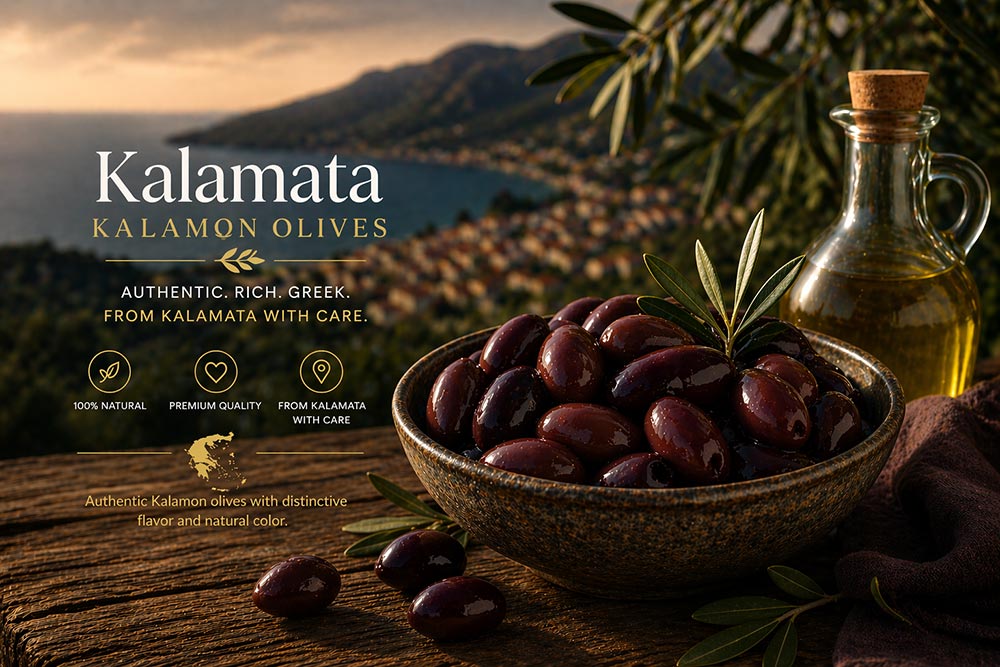
Not all dark olives are interchangeable. Greek Kalamon olives are prized because of a specific combination of variety, terroir, and processing. The fruit itself is naturally elongated, glossy, and meaty, with a firm skin and a distinctive balance of fruity richness, mild bitterness, and a subtle almond-like finish.
Greek origin plays a major role here. Soil conditions, sun exposure, local agricultural practices, and harvest timing all shape the final character of the olive. Regions in southern Greece, including areas associated with the Peloponnese, have built a global reputation for table olives that taste fuller and more complex than mass-market alternatives.
Then there’s curing. Traditional natural brine curing or lacto-fermentation takes time, but it preserves texture and creates layered flavor. Faster industrial shortcuts can flatten taste or leave olives softer, saltier, or one-dimensional. And buyers notice. A restaurant using olives on antipasti platters or premium salads wants fruit that holds its shape and delivers bite, not something mushy or overly acidic.
We should also pay attention to harvest maturity. Early-picked fruit may be firmer and sharper: fully ripened olives tend to develop deeper color and rounder flavor. The best producers know how to balance those traits according to the final market.
So when we compare suppliers, flavor quality isn’t accidental. It comes from a chain of decisions: Greek origin, true Kalamon variety, careful harvest, and patient curing. Miss one link, and the difference ends up in the jar.
What A Reliable Producer Should Offer From Harvest To Processing
A serious olive producer does much more than grow fruit. They manage quality from the grove to the finished packed product. That full-chain control is often what separates dependable Greek suppliers from traders who simply source and resell.
At harvest level, we want to see selective picking, often by hand or with careful low-impact methods that reduce bruising. Kalamon olives are delicate enough that rough handling shows up later in texture and appearance. A reliable producer should be able to explain harvest windows, maturity targets, and how fruit moves quickly from grove to processing.
Processing is the next checkpoint. Good suppliers monitor fermentation, brine composition, size grading, and defect removal with real discipline. They should be able to provide clear product specs: size counts, pH, salt range, drained weight, and packaging options. If they can’t produce a clean specification sheet, that’s usually a warning sign.
Certifications matter too. At minimum, wholesale buyers should expect systems aligned with HACCP and often ISO standards, especially for export markets. But paperwork alone isn’t enough. We also want responsiveness, lot-level traceability, and honest communication when harvest volume changes.
This is where producers with a strong estate or integrated sourcing model stand out. Brands rooted in Greek olive tradition, including suppliers like Elaia Gaia Olives, often emphasize authenticity, clean ingredients, and minimal compromise in processing. That kind of positioning resonates because buyers increasingly want not just olives, but a credible production story behind them.
In short, the right producer protects quality before the product ever reaches a container.
Key Product Formats For Wholesale Buyers And Food Businesses
Wholesale buyers rarely need just one olive format. Retailers, distributors, deli counters, meal manufacturers, and restaurants all use Kalamon olives differently, so flexibility matters almost as much as quality.
The best suppliers understand that format affects labor, shelf presentation, menu use, and cost control. A foodservice buyer may prioritize speed and consistency. A retailer may care more about shelf appeal and label differentiation. A manufacturer may need exact cut specifications for production lines.
That’s why a capable kalamata kalamon olives producer supplier wholesale exporter should offer multiple ready-to-sell and ready-to-use options, along with technical guidance on which format best fits each channel. Below are the two format areas that usually matter most.
Whole, Pitted, Sliced, And Marinated Options
Whole olives are the classic choice for premium retail jars, antipasti, charcuterie boards, and salad bars. They communicate authenticity and usually preserve the best texture. For gourmet positioning, whole Kalamon olives often make the strongest impression.
Pitted olives are a practical favorite for foodservice and home cooking because they remove prep time. They’re ideal for pizzas, grain bowls, tapenades, and ready-made salads. Sliced olives go one step further, helping manufacturers and commercial kitchens portion quickly and evenly across recipes.
Marinated options add another layer of value. Herbs, garlic, citrus, chili, or olive oil-based seasoning can turn a standard olive line into a premium deli or specialty retail offering. But the marinade should support the olive, not hide it. If a supplier leans too heavily on seasoning, it can sometimes signal average raw material underneath.
We should match the format to the business model. Convenience sells in high-volume operations: whole-fruit integrity wins in more premium settings.
Bulk Packaging, Private Label, And Custom Specifications
Bulk packaging is where B2B buying gets very practical. Reliable exporters commonly offer olives in brine-packed PET containers, tins, pouches, or large foodservice jars, often around 2 kg and upward depending on the market. The right pack depends on storage, transport costs, handling speed, and customer preference.
Private label is another major consideration. Retail chains and specialty food brands increasingly want authentic Greek olives under their own branding, but they still need a supplier with formulation control, packaging know-how, and export experience. A good partner can adapt labels, languages, nutritional panels, and pack sizes without turning the project into chaos.
Custom specifications matter just as much. Buyers may request specific olive sizes, salt levels, marinade profiles, drained weights, or packaging materials. The more clearly a supplier can document and consistently reproduce those specs, the easier it is to scale.
This is one of those details that sounds boring until it goes wrong. If every shipment tastes slightly different or arrives in a different grade, operations get messy fast. Consistency is a product format issue as much as a sourcing issue.
What To Look For In An Olive Exporter Serving International Markets
Exporting olives is not just about having a good crop. It’s about managing documentation, logistics, compliance, and customer communication across borders. A supplier may produce excellent olives and still be a poor export partner if they can’t handle international trade smoothly.
First, we should look for proven market reach. An exporter serving multiple countries usually has stronger systems for labeling, shipping documents, and destination-specific requirements. Experience with customs, freight coordination, and shelf-life management matters more than many buyers realize.
Second, responsiveness counts. International buyers need timely answers on lead times, minimum order quantities, private label timelines, and product specs. Slow communication before the sale often predicts even slower communication after the container is booked.
Third, exporters should understand market positioning. Premium Greek Kalamon olives belong in a different commercial category from low-cost imitation products. A good exporter helps buyers protect that distinction rather than competing only on price.
We also recommend checking whether the exporter works closely with producers or operates as a disconnected trader. Direct ties to estates or processing facilities usually mean better traceability, stronger quality control, and fewer surprises.
And yes, reviews and reputation still matter. If chefs, importers, or retail buyers consistently mention dependable quality and honest service, that’s valuable evidence. In olive exports, reliability is part of the product.
How To Evaluate Food Safety, Traceability, And Consistent Supply
For retail and foodservice buyers, this may be the most important section of all. Great flavor gets attention, but food safety and supply consistency keep a business running.
We should start with certifications and documented systems. Look for HACCP-based controls, ISO-aligned processes, and any market-specific compliance relevant to your region. Ask for product specifications, microbiological standards, allergen information where applicable, and shelf-life data. Serious suppliers provide these without drama.
Traceability is the next test. Can the exporter identify the grove, lot, harvest period, and processing batch tied to a shipment? If there’s ever a quality issue, lot-level traceability saves time, protects retailers, and reduces risk. Vague answers here are a red flag.
Then comes supply reliability. Olive harvests vary by season, weather, and region, so we should ask direct questions: What does the supplier do in lower-yield years? Do they maintain contracted grower networks? Can they guarantee continuity for annual programs? A polished website is nice: a realistic supply plan is better.
Sampling should also be part of the evaluation process. Review taste, texture, size consistency, brine balance, and appearance across more than one batch if possible. One excellent sample doesn’t prove long-term consistency.
Finally, check how the supplier handles problems. Every food business eventually faces delays or deviations. The best partners communicate early, offer documentation fast, and work toward solutions instead of excuses. That’s usually the real difference between a vendor and a dependable long-term wholesale partner.
Best Uses For Kalamon Olives In Retail, Foodservice, And Gourmet Cooking
One reason Kalamon olives remain in such high demand is their versatility. Their firm bite, rich color, and balanced flavor make them work across retail shelves, restaurant menus, and home kitchens without feeling generic.
In retail, they perform well in premium jars, snack packs, antipasti mixes, and Mediterranean pantry lines. Health-conscious consumers often gravitate toward them because they feel both indulgent and naturally simple. Clean-label positioning helps too, especially when the ingredient list stays short.
In foodservice, Kalamon olives pull their weight in Greek salads, pasta dishes, pizzas, focaccia, grain bowls, marinades, and mezze platters. Pitted formats are especially useful here because they save prep time while still delivering a more upscale flavor than standard black olives.
For gourmet cooking, these olives shine on charcuterie boards, with feta and roasted peppers, folded into tapenade, or paired with citrus, oregano, and good extra virgin olive oil. They also hold up beautifully in slow dishes where softer olives might disappear.
And that’s really the commercial advantage: they’re adaptable without becoming ordinary. For brands and buyers who want an ingredient that signals authentic Mediterranean character, genuine Greek Kalamon olives do a lot of work with very little effort.
Conclusion
Choosing the right supplier means looking past the label and into the full story of the olive. When we compare Kalamata and Kalamon olives, the smartest buying decisions come down to authentic Greek origin, careful curing, strong certifications, export capability, and dependable format options for real-world business needs.
If we want olives that deliver flavor, traceability, and premium market value, we should prioritize producers and exporters who can prove what they grow, how they process it, and how consistently they supply it. In a crowded market full of lookalikes, authenticity is still the clearest advantage.
Frequently Asked Questions about Kalamata Kalamon Olives
What is the difference between Kalamata and Kalamon olives?
Kalamon is the olive variety grown mainly in Greece, while Kalamata refers to olives of this variety typically from the Peloponnese region. Kalamata indicates geographic origin, ensuring authentic Greek olives with specific flavor and quality profiles.
How does the Greek origin affect the quality of Kalamata Kalamon olives?
Greek origin provides unique terroir—soil, climate, and cultivation—that shapes their rich, fruity, and almond-like flavor. Authentic Greek olives undergo traditional curing methods like natural brine fermentation, which preserve texture and complexity.
What certifications should I look for when choosing a Kalamata Kalamon olives supplier?
Reliable suppliers have certifications like HACCP and ISO, ensuring food safety, traceability, and compliance with export standards, which are crucial for consistent quality and safe international trade.
What product formats are available for wholesale buyers of Kalamata Kalamon olives?
Suppliers typically offer whole, pitted, sliced, and marinated olives in bulk packaging such as 2kg brine jars, tins, PET containers, and pouches. Private label and custom specifications are also common to meet diverse business needs.
How can I verify the authenticity of a Kalamata Kalamon olives producer or exporter?
Check for transparent sourcing tied to Greek estates, detailed product specifications, certifications, lot-level traceability, export experience in multiple countries, and positive client reviews highlighting reliability and product quality.
What are the best uses of Kalamata Kalamon olives in foodservice and retail?
They excel in retail antipasti and snack packs, foodservice dishes like Greek salads, pizzas, and marinades, and gourmet cooking such as charcuterie boards due to their firm texture and rich, balanced flavor.